In the 1960s, families would sit around the TV set together after their evening meal. Primary school meant no homework, so from the time I got home until bedtime, most evenings were spent glued to the box, with a brief interlude for supper. Like in every other household. After children's TV - BBC - we were (lower) middle class - it would be the early evening news, followed by Town and Around (replaced in 1969 by Nationwide), the local current affairs programme.
From 1965 onwards, Town and Around was followed on Wednesdays by Tomorrow's World, a popular science programme dedicated to bringing the future of technology to your living room. Presented at the time I watched it most by Raymond Baxter and James Burke, it created the impression (which turned out to be correct) that our lives would indeed be changed by the gadgets being invented by science.
Yet the Wikipedia page about Tomorrow's World indicates that actually precious little by way of life-changing inventions appeared in the 1960s on this programme, other than the breathalyser and the cash machine. More typical fare (apart from all the fascinating space race stuff culminating in the moon landing) was the widely advertised programme about a new technology that allowed you to watch colour TV on a standard black and white set.
This post was prompted by a vivid flashback I had to that very show, discussed avidly in the school playground before and after its broadcast. Looking at the LED screen on the 709 bus home from Wilanowska yesterday, watching the little lights rearrange to form the name of the next stop and the current time, brought back memories of that very programme, some 40 years ago.
Read about it here, and the theory behind it here.
Tuesday, 30 September 2008


Tuesday, 23 September 2008
Of bread and cakes
A flashback the other day, prompted by the cakey smell of icing sugar. On the Uxbridge Road in West Ealing, across the road from Woolworth's, there was a cake shop. In the window were wedding cakes and birthday cakes, demonstrating the shop's artistry. The smell inside was characteristic; sweet, marzipan, icing sugar, shortening. Battenberg cakes, Bakewell tarts, custard pies small and large in tin foil, cakes with hundreds and thousands on top, cakes with little metal ballbearings on top... Very, very rarely, I'd go in with my mother to buy a cake here.
More often, we'd go across the road, past British Home Stores, towards Hanwell, to T. Parker's Bakery. Here the smell was of fresh bread, rolls and buns. My mother would buy both bread that was typically English - white sliced, granary, and continental - croissants with poppy-seed, challa, baguettes. Parker's has closed down on the Uxbridge Road, but the shop on Northfields Avenue is still in business (it opened in 1913).
More often, we'd go across the road, past British Home Stores, towards Hanwell, to T. Parker's Bakery. Here the smell was of fresh bread, rolls and buns. My mother would buy both bread that was typically English - white sliced, granary, and continental - croissants with poppy-seed, challa, baguettes. Parker's has closed down on the Uxbridge Road, but the shop on Northfields Avenue is still in business (it opened in 1913).
Wednesday, 17 September 2008
Wireless memories

The radio in our house was a Barker, a wooden box with bakelite knobs and valves that glowed. The panel on the right would be gently back-lit, with stations such as Hilversum, Luxembourg, Droitwich, Athlone and many others on short, medium and long waves. After switching on the radio, you'd have to wait several seconds for the valves to warm up.
As I recall, the radio came from Barkers' department store on High Street Kensington. My parents lived in an attic flat on Sinclair Road in West Kensington before buying the house on Croft Gardens. My mother would often use the phrase "kupiliśmy u Barkersa" relating to the provenance of things around our house ("we bought it at Barkers").
Mostly, the radio would be tuned to either the BBC's Light Programme (my mother listening to Housewife's Choice or Music While You Work), the Home Service or the Third Programme (for those occasions when my father spotted some piece of classical music he wanted to hear). Saturday mornings would be Children's Favourites; and on Sundays, the Light Programme would broadcast The Billy Cotton Band Show, followed by The Clitheroe Kid, followed by Family Favourites.
But twiddling with the tuner knob would bring other, more exotic radio stations to life. Moscow's Radio Mayak, or Polish Radio, each with their characteristic station ident tune played on xylophone (Midnight in Moscow; Warszawianka).
Between stations, the tuner would summon forth an unearthly rising and falling tone, accompanied by crackle and distortion, that to me epitomised the romance of the airwaves
My parents' radio went out in a blaze of glory; the picture above is a still from the video directed by Nick Morris for The Bluebell's smash hit Young at Heart, four weeks at No. 1 in the UK singles charts, you'll see the radio itself (and indeed myself for a second or two, then aged 26). By then, the radio was long broken (the tuner knob's fallen off and the tuner indicator's at a funny angle). The old Barker radio fell into disuse around the same time as the Light Programme gave way to modern and with-it BBC Radios 1 and 2, the Third Programme by Radio 3 and the Home Service by Radio 4, in 1967. The Barker's replacement was a modern hi-fi with separate record player, tuner and amplifier.
Wednesday, 10 September 2008
Lego boy
Danish toymaker Lego is celebrating its 50th anniversary. I saw a boxed set of bricks brought out to celebrate the milestone in our local hypermarket. This immediately evoked a rush of nostalgic feeling towards the plastic building blocks that were such an important part of my childhood (and indeed, my children's childhood!)
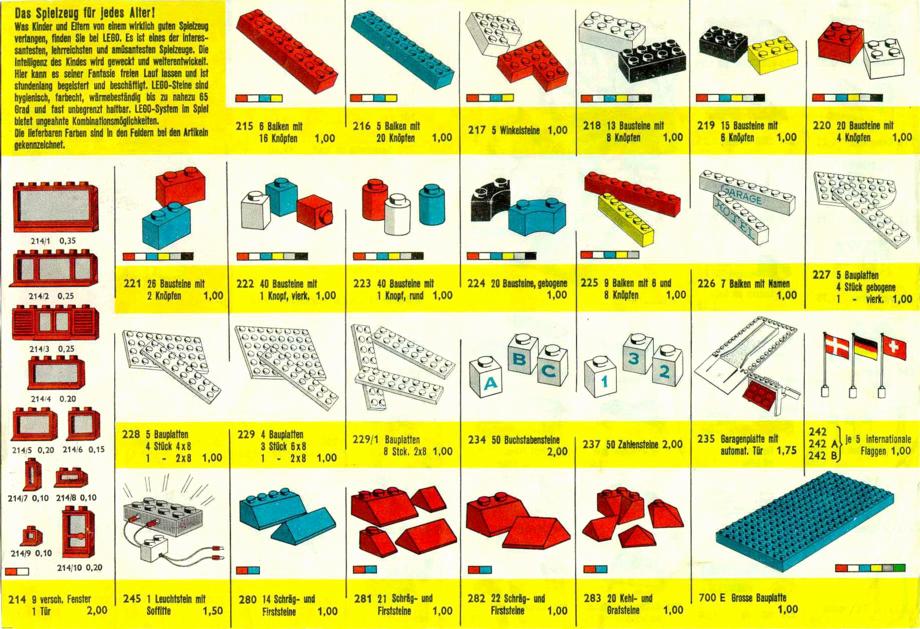
I vividly recall the colours of the bricks - white, yellow, red and blue, the interlocking studs with the Lego logo on each one, the shapes of the bricks (especially the roof tiles, the rounded pieces, the clear pieces), and special parts such as the Scandinavian flag set (memorably recalled in a flashback while standing outside Warsaw's Radisson SAS hotel on a frosty night), and the small Lego cars and trucks (I had a Bedford furniture truck, with opening door at rear).
I must have been about four when I received my first Lego set, but have perfect recollection of the emotions I felt at the time I opened the box and started putting the pieces together for the first time. Just writing this piece makes me remember the kit, a kiosk with a rounded end, I recall unfolding the instructions.
Follow this link to a German-language page with Lego catalogues from the 1950s and early 1960s. I well recall most of the bricks displayed; it also jogged memories (I had the Lego garage set with up-and-over door).
I vividly recall the colours of the bricks - white, yellow, red and blue, the interlocking studs with the Lego logo on each one, the shapes of the bricks (especially the roof tiles, the rounded pieces, the clear pieces), and special parts such as the Scandinavian flag set (memorably recalled in a flashback while standing outside Warsaw's Radisson SAS hotel on a frosty night), and the small Lego cars and trucks (I had a Bedford furniture truck, with opening door at rear).
I must have been about four when I received my first Lego set, but have perfect recollection of the emotions I felt at the time I opened the box and started putting the pieces together for the first time. Just writing this piece makes me remember the kit, a kiosk with a rounded end, I recall unfolding the instructions.
Follow this link to a German-language page with Lego catalogues from the 1950s and early 1960s. I well recall most of the bricks displayed; it also jogged memories (I had the Lego garage set with up-and-over door).
Monday, 8 September 2008
Holiday on the Isle of Wight.
Sitting here by the computer, I just had an involuntary, entirely spontaneous flashback, a propos of nothing at all - a childhood holiday on the Isle of Wight. Bembridge. August 1964; my brother would have been one and half, me, I'd have been six and a bit.
I remember the village, its green, our rented holiday house just off the green; Southern Vectis double decker buses, light green in colour. I remember the lead paint scare; toys made in Hong Kong (for that is where cheap toys came from - the euphemism was "Empire Made") that had red paint on them were so full of lead that if you sucked them (so my mother said), your brain would come to a standstill.
The double deckers were an attraction to me. Because we were middle class (just!) and had a car, I very rarely travelled by public transport, and so, a bus journey was an departure into the exotic. During this holiday, I once went by bus with my father, just a few stops, upstairs of course, on the top deck, which was very exciting. I remember the harbour, the smell of the sea; the weather was nice, too.
We drove all over the island - Blackgang Chine, Alum Sands, Ventnor, Ryde... at Cowes, we saw, across the water, the gargantuan bulk of Britain's largest flying boat, the Saunders-Roe Princess, in mothballs, awaiting the scrappers' blowtorch.
 Above: What's brown and comes steaming out of Cowes? The Isle of Wight Ferry. Its load here - a new Leyland truck bringing Calor Gas the the island's caravanners. To the left, in the distance, the cocooned Princess.
 Above: A more modern way (well, in 1964 at least) of getting to the mainland - a Saunders-Roe SRN2 hovercraft makes it up Ryde beach to unload passengers. That's me covering my ears. As well as being extremely loud, the hovercraft's air cushion would blow sand and grit at high velocity, stinging the skin. Both pictures by my father, Bohdan Dembinski
I remember the village, its green, our rented holiday house just off the green; Southern Vectis double decker buses, light green in colour. I remember the lead paint scare; toys made in Hong Kong (for that is where cheap toys came from - the euphemism was "Empire Made") that had red paint on them were so full of lead that if you sucked them (so my mother said), your brain would come to a standstill.
The double deckers were an attraction to me. Because we were middle class (just!) and had a car, I very rarely travelled by public transport, and so, a bus journey was an departure into the exotic. During this holiday, I once went by bus with my father, just a few stops, upstairs of course, on the top deck, which was very exciting. I remember the harbour, the smell of the sea; the weather was nice, too.
We drove all over the island - Blackgang Chine, Alum Sands, Ventnor, Ryde... at Cowes, we saw, across the water, the gargantuan bulk of Britain's largest flying boat, the Saunders-Roe Princess, in mothballs, awaiting the scrappers' blowtorch.
 Above: What's brown and comes steaming out of Cowes? The Isle of Wight Ferry. Its load here - a new Leyland truck bringing Calor Gas the the island's caravanners. To the left, in the distance, the cocooned Princess.
 Above: A more modern way (well, in 1964 at least) of getting to the mainland - a Saunders-Roe SRN2 hovercraft makes it up Ryde beach to unload passengers. That's me covering my ears. As well as being extremely loud, the hovercraft's air cushion would blow sand and grit at high velocity, stinging the skin. Both pictures by my father, Bohdan Dembinski
Wednesday, 3 September 2008
Playtime at Oaklands
"All-in-for-US-Cavalry" the boys would chant, as they formed a huge chain around the Junior boys' playground during playtime. More and more would join, and once a critical mass was attained, the chain would split up into cowboys and Indians, and play proper would begin. As well as US Cavalry, obviously inspired by what was going on at ABC Minors at the time, there would be "All-in-for-Zulus-and-Welsh" (the 1964 movie Zulu). Note the Anglo-Saxon imperialists vs. Natives theme in both games. Oftentimes the chain of boys, arms around one another's shoulders, would form under the shelter at the side of the playground opposite the school building. Here was a long wooden bench, the boys would stand on the bench stamping their feet in time in a show of play masculine aggression.
Other games played in the playground; the classic British Bulldog ("British Bulldog One Two Three!"), Chain-he, was a game based on tag, where two boys holding hands chased others running around on their own; when tagged, the boy would join the chain, until the entire playground was one long chain trying to catch the last single boys out there. There were also piggy-back fights, with two teams of horses and riders, trying to pull the others down. A sophisticated variation on this was chariot racing (or fights) in which two boys (the horses) would link arms, between them, bending down, a third boy (the chariot), usually big and strong, and a fourth boy (the charioteer) sitting on the back of the 'chariot' boy, who was supported by the two 'horses'. Two or more ensembles like this would smash into one another, the aim being to physically break up the other team.
While the boys were busy in rough-and-tumble, the Junior girls (who shared a playground with the Infants) would also be parading around arms around each others' shoulders, emulating the Tiller Girls and performing high kicks. "Keep your sunny side UP! UP!" they would sing as they danced around the playground together.
These were the 1960s, but the traditions that we children were drawing on were already decades old; each generation learning from the older children that went before.
Other games played in the playground; the classic British Bulldog ("British Bulldog One Two Three!"), Chain-he, was a game based on tag, where two boys holding hands chased others running around on their own; when tagged, the boy would join the chain, until the entire playground was one long chain trying to catch the last single boys out there. There were also piggy-back fights, with two teams of horses and riders, trying to pull the others down. A sophisticated variation on this was chariot racing (or fights) in which two boys (the horses) would link arms, between them, bending down, a third boy (the chariot), usually big and strong, and a fourth boy (the charioteer) sitting on the back of the 'chariot' boy, who was supported by the two 'horses'. Two or more ensembles like this would smash into one another, the aim being to physically break up the other team.
While the boys were busy in rough-and-tumble, the Junior girls (who shared a playground with the Infants) would also be parading around arms around each others' shoulders, emulating the Tiller Girls and performing high kicks. "Keep your sunny side UP! UP!" they would sing as they danced around the playground together.
These were the 1960s, but the traditions that we children were drawing on were already decades old; each generation learning from the older children that went before.
Subscribe to:
Posts (Atom)